Water leaves a treatment plant clean, then travels miles of pipe to reach you. Utilities add a disinfectant that stays in the water for that trip, so germs can’t grow along the way. It’s either chlorine or chloramine, which is chlorine combined with a small amount of ammonia.
Why some cities switched to chloramine
Utilities have used chloramine since the 1930s, according to EPA. It lasts longer in long pipe networks, and it forms fewer of the regulated byproducts chlorine creates when it reacts with natural organic matter. EPA says some utilities moved to chloramine to meet those byproduct rules. More than one in five Americans now drink water treated with it.
EPA’s limit is the same for both: 4.0 mg/L in tap water.
Which one your city uses
Chloramine (20)
- Austin, TX
- Boston, MA
- Dallas, TX
- Denver, CO
- Fort Worth, TX
- Houston, TX
- Indianapolis, IN
- Kansas City, MO
- Los Angeles, CA
- Louisville, KY
- Miami, FL
- Milwaukee, WI
- Minneapolis, MN
- Oklahoma City, OK
- Philadelphia, PA
- Portland, OR
- San Diego, CA
- San Francisco, CA
- Tampa, FL
- Washington, DC
Free chlorine (19)
- Albuquerque, NM
- Atlanta, GA
- Baltimore, MD
- Charlotte, NC
- Chicago, IL
- Cincinnati, OH
- Cleveland, OH
- Columbus, OH
- Detroit, MI
- El Paso, TX
- Jacksonville, FL
- Las Vegas, NV
- Memphis, TN
- Nashville, TN
- New York, NY
- Phoenix, AZ
- San Antonio, TX
- Seattle, WA
- Tucson, AZ
Chlorine and chloramine (1)
“Chlorine and chloramine” means the system uses chloramine at some sampling points and chlorine at others, usually because it blends water from different plants or wells.
Filtering each one
- Chlorine comes out easily with ordinary activated carbon, from a pitcher to a whole-house unit. NSF/ANSI 42 certification for chlorine reduction is the proof.
- Chloramine needs more. Ordinary carbon removes it slowly, so look for catalytic carbon or a filter certified to NSF/ANSI 42 for chloramine reduction.
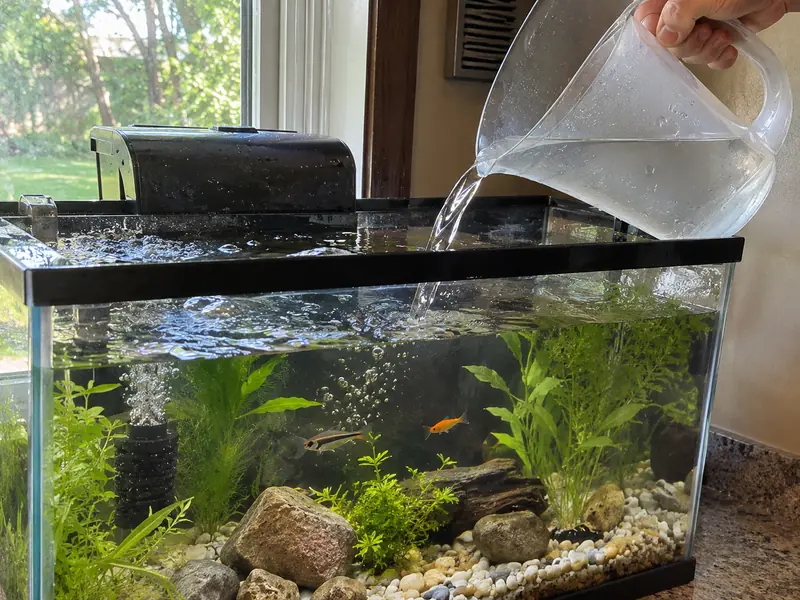
Two groups have to remove chloramine completely: dialysis equipment and fish tanks. Utilities that use chloramine tell those customers, and pet stores sell water conditioners made for it.
What the research says
Health agencies describe chlorine and chloramine at tap-water levels as acceptable for drinking and bathing, and two groups as the exceptions: dialysis and fish. EPA also notes there are few studies on chloramine itself. Complaints about skin after cities switched to chloramine have been investigated, without clear conclusions, and we found no controlled study of showering in chlorinated tap water and skin or hair.
- Strong evidenceFederal health and environmental agency guidance
CDC and EPA say chlorine or chloramine at the levels allowed in tap water, up to 4 mg/L, are considered safe for drinking, cooking and bathing.
Limits: Agency summary statements. EPA’s 2009 Q&A also notes 'few studies on how monochloramine affects human health' and that chloramine can make water more corrosive (a lead risk) if utilities do not manage it.
Centers for Disease Control and Prevention. About Water Disinfection with Chlori
- Moderate evidenceFederal agency Q&A document
EPA itself notes there are few studies on how chloramine affects human health and on the byproducts it forms, and that it can make water more corrosive unless utilities control it.
Limits: Document dated 2009.
US EPA. (2009). Chloramines-Related Research, Question 18: What does EPA see as
- Strong evidenceFederal agency guidance plus clinical review of outbreak reports
Chloramine must be removed from water used for kidney dialysis, because it passes into the blood during dialysis and has caused outbreaks of anemia when filters failed.
Limits: Ward review is from 1996; abstract only (paywalled). Risk applies to dialysis, not to drinking or bathing.
Centers for Disease Control and Prevention. About Water Disinfection with Chlori
- Strong evidenceFederal health agency guidance
CDC says fish, turtles and frogs should not be kept in chlorinated or chloraminated tap water, and that letting water sit does not remove chloramine.
Limits: Guidance statement; no dose figures for fish.
Centers for Disease Control and Prevention. About Water Disinfection with Chlori
- Strong evidenceFederal ambient water-quality criteria
EPA’s water-quality criteria for protecting freshwater fish set chlorine limits in micrograms per liter, far below the milligram levels allowed in tap water.
Limits: Criteria are for chlorine in rivers and lakes, from 1986, and not specific to monochloramine or aquarium species; the comparison to tap water is our arithmetic.
US EPA. National Recommended Water Quality Criteria - Aquatic Life Criteria Tabl
- Weak evidenceCase report / complaint investigation by a city health department
After San Francisco switched to chloramine, health officials interviewed 17 residents with skin complaints and found symptoms too varied, with other plausible causes, to recommend further study.
Limits: Abstract read (open access via PMC1508142). Tiny, self-selected group; no comparison group; cannot rule a link in or out.
- Weak evidenceFederal agency Q&A summarizing a CDC/EPA preliminary investigation
EPA reports that a CDC investigation of community complaints about chloramine could not draw any conclusions about chloramine and health effects.
Limits: The CDC trip report itself was not opened (old healthvermont.gov link). Investigation was not a research study.
US EPA. (2009). Common Health Questions Related to Monochloramine, Question 28:
- Weak evidenceCross-sectional, mechanistic and ecological studies
Studies that tested tap-water chlorine alongside hardness have not found a clear independent effect of chlorine on eczema or skin irritation.
Limits: No study found that directly tests showering in chlorinated or chloraminated tap water on skin dryness or hair in a controlled way. Chlorine and hardness are often correlated. Danby was industry-funded.
Questions
How do I know if my water has chlorine or chloramine?
Your utility’s annual water quality report says which disinfectant it uses. Every city page on this site lists it, from the utility’s report or the disinfectant types it reported to the U.S. Environmental Protection Agency (EPA).
Does a carbon filter remove chloramine?
Slowly. Ordinary activated carbon removes chlorine well but needs much more contact time for chloramine. Catalytic carbon, or a filter certified to NSF/ANSI 42 for chloramine reduction, is the one to look for.
Is chloramine safe to drink?
The U.S. Environmental Protection Agency (EPA) says water treated with chloramine that meets its standards is safe for drinking, cooking and bathing. Its limit for chloramine in tap water is 4.0 milligrams per liter (mg/L), the same as for chlorine.