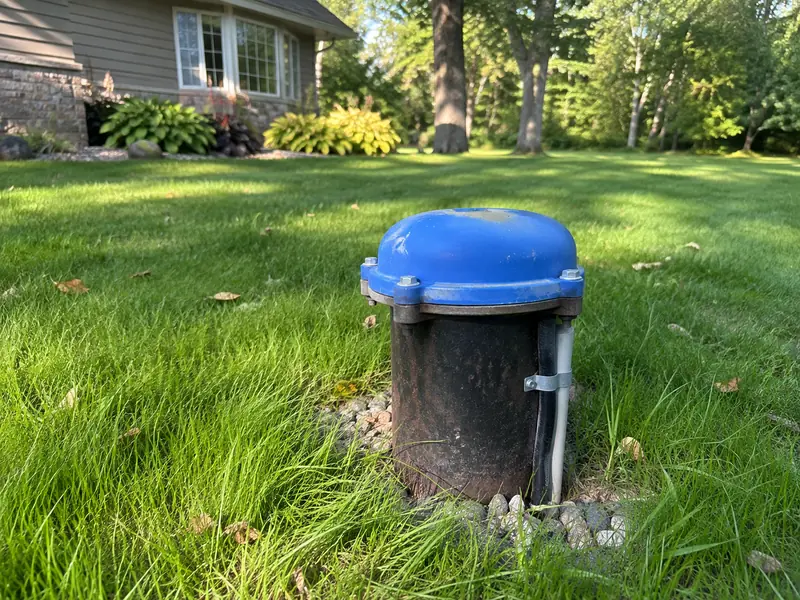
About 15% of Americans get their water from a private well. No utility tests or treats it, and the federal government doesn’t regulate it: the U.S. Environmental Protection Agency (EPA) says private well owners are “responsible for delivering safe drinking water to their households.” What to do depends entirely on what a test finds.
Start with a test
Treatment equipment fixes specific problems, and a well can have one, several or none. A lab test tells you which. EPA recommends testing every year for total coliform bacteria, nitrate, total dissolved solids and pH. For choosing treatment, add hardness, iron, manganese and, if there’s a smell, hydrogen sulfide. Our well testing guide covers what to test and where.
What fixes what
| Problem | How you notice it | What fixes it |
|---|---|---|
| Hardness | White scale on fixtures, spotty dishes, poor lather | A water softener |
| Iron | Clear water that turns rusty after standing; orange or brown stains | A softener for small amounts; an oxidizing iron filter for more |
| Manganese | Black specks or stains, metallic taste | A softener for small amounts; an oxidizing filter for more |
| Hydrogen sulfide | Rotten-egg smell; yellow or black stains | Carbon for low levels; aeration or an oxidizing filter for more |
| Bacteria | Often none; sometimes repeated stomach illness | Fix the well, shock-chlorinate; ultraviolet light if they come back |
| Acidic water | Blue-green stains, metallic taste, pinhole leaks | A calcite neutralizer, or soda ash injection |
| Sediment | Cloudy or gritty water | A sediment filter |
| Nitrate | None: no taste, smell or color | Reverse osmosis, ion exchange or distillation at the kitchen tap |
| Arsenic | None | Reverse osmosis or adsorptive media at the kitchen tap |
| Uranium | None | Reverse osmosis, distillation or anion exchange |
| Lead | None; it usually comes from plumbing, not the well | A certified filter at the tap, and fixing acidic water |
The last four rows are the reason to test: nitrate, arsenic, uranium and lead have no taste, smell or color. Sources: Penn State Extension’s table of common well water problems and the Minnesota Department of Health.
Iron and manganese
Iron and manganese are common in well water. EPA’s guidelines are 0.3 milligrams per liter (mg/L) for iron and 0.05 mg/L for manganese. Those are “secondary” standards, set for taste and staining, and EPA doesn’t enforce them. Manganese also has a health benchmark: Penn State Extension cites EPA’s lifetime health advisory of 0.3 mg/L, and the Minnesota Department of Health advises keeping it under 100 micrograms per liter (µg/L) in water a baby drinks.
What fixes them depends on how much there is. Penn State Extension’s guidelines:
- A water softener for dissolved iron under 5 mg/L, if the water’s pH is above 6.7. Some softeners are rated for only 2 mg/L, so check the model.
- A greensand filter for about 3 to 10 mg/L of iron and manganese combined.
- Oxidation followed by filtration above that. This is what air-injection iron filters do: they turn dissolved iron into particles, then catch them.
Two cautions for softeners. Iron that has already turned rusty, and iron bacteria, clog a softener’s resin instead of being removed by it. And removing iron uses up some of a softener’s capacity, so a softener on iron-bearing water should be sized up; our sizing calculator gives the starting number.
The rotten-egg smell
That smell is hydrogen sulfide gas. Before buying anything, smell the hot and cold taps separately after the water has sat for a few hours.
- Only the hot water smells: the usual cause is the water heater’s magnesium anode rod reacting with the water. Penn State Extension says replacing it with an aluminum rod should eliminate the odor. Don’t just remove the rod: that shortens the heater’s life and will likely void its warranty.
- Both taps smell: the gas is in the well water. Penn State Extension’s guide: activated carbon for under about 1 mg/L, aeration up to about 2 mg/L, and an oxidizing filter above that (Minnesota’s health department puts oxidizing filters’ range as high as 6 mg/L). Continuous chlorination handles the highest levels.
Shock-chlorinating the well doesn’t fix it; the smell returns quickly.
Bacteria
Total coliform bacteria in a test are a warning sign that surface water or waste may be reaching the well; E. coli points to human or animal waste. Fix the cause before treating the water: a tight, sanitary well cap and a casing that extends above the ground. Then shock-chlorinate the well and retest. Until a test comes back clean, boiling kills bacteria, though CDC notes it won’t remove chemicals.
If bacteria come back, the fix is continuous disinfection, most often ultraviolet (UV) light. A UV system for a well should be certified to NSF/ANSI 55 Class A, the class for disinfection; Ohio’s health department allows only Class A for that job. UV needs clear water to work, so it goes last in line: Ohio’s guidance says to treat iron at 0.3 parts per million (ppm) or more and hardness at 6 grains per gallon or more first, because both coat the lamp’s sleeve. UV also leaves nothing behind in the pipes to keep killing germs, which is why fixing the well comes first.
Nitrate, arsenic and uranium
None of these has a taste, smell or color, so only a test finds them. EPA’s limits for public water, the usual benchmark for wells:
- Nitrate: 10 mg/L measured as nitrogen. Some labs report it as nitrate instead, where the same limit is 45 mg/L, so check the units on your report.
- Arsenic: 0.010 mg/L, the same as 10 µg/L.
- Uranium: 30 µg/L.
The fix is usually at the kitchen tap, where you drink and cook: reverse osmosis, distillation or ion exchange. For arsenic, the form matters; Penn State Extension says every treatment works better when the water is oxidized first. Softeners don’t remove nitrate or arsenic, and boiling makes both more concentrated.
Acidic water
Water with a pH under 6.5 is acidic, below the range in EPA’s secondary standards (6.5 to 8.5). It eats at copper pipes, leaving blue-green stains and eventually pinhole leaks, and can pull lead from older plumbing, so test lead and copper at the tap too.
A calcite neutralizer raises the pH by dissolving a little calcium into the water. It adds some hardness and needs refilling. Virginia Tech Extension says neutralizers work down to a pH of about 5.3; below that, soda ash injection is the fix, and it doesn’t add hardness. New plumbing alone won’t help, since the water stays corrosive.
The order on the line
Rusty iron and iron bacteria clog softener resin, and UV needs clear water. So when a well needs several kinds of treatment, the usual order is: a sediment filter, then the iron and sulfur filter, then the softener, with UV last. Equipment for drinking water only, like reverse osmosis, goes under the kitchen sink.
What well equipment costs
These are the sellers’ own prices, read on November 4, 2026. What each system treats is the seller’s description; a water test decides which, if any, your well needs. Most stores show these as sales against a higher list price, and those come and go.
Iron, manganese and sulfur filters
Iron and sulfur filter prices
Sellers’ own prices, read Nov 2026
- Waterdrop · WD-WHF21-PG 2-stage cartridge system with iron and manganese cartridge$237
- iSpring · WGB31BCM 3-stage iron and manganese cartridge system$316
- Waterdrop · WD-WHF3T-FG 3-stage iron and manganese cartridge system$420
- iSpring · WGB32B-MKS 3-stage cartridge system for iron, manganese and hydrogen sulfide$609
- SoftPro · Iron Master air-injection iron filter$1,517 to $1,897
by size
- SpringWell · Whole house well water filter (air injection, for iron, manganese and sulfur)$2,231 to $2,678
by house size
- US Water Systems · Flexx InFusion iron and sulfur system$2,595 to $2,895
by size
- US Water Systems · Flexx Oxi-Gen aeration iron and sulfur filter$2,695 to $3,195
by size
- Kind Water · Chemical-free iron, manganese and sulfur filter$2,824
- US Water Systems · Matrixx Greensand Plus iron filter$4,036 to $4,666
by size
| Brand | Price | System | Store link |
|---|---|---|---|
| Waterdrop | $237 | WD-WHF21-PG 2-stage cartridge system with iron and manganese cartridge | Check price |
| iSpring | $316 | WGB31BCM 3-stage iron and manganese cartridge system | Check price |
| Waterdrop | $420 | WD-WHF3T-FG 3-stage iron and manganese cartridge system | Check price |
| iSpring | $609 | WGB32B-MKS 3-stage cartridge system for iron, manganese and hydrogen sulfide | Check price |
| SoftPro | $1,517 to $1,897on sale | Iron Master air-injection iron filterby size | Check price |
| SpringWell | $2,231 to $2,678on sale | Whole house well water filter (air injection, for iron, manganese and sulfur)by house size | Check price |
| US Water Systems | $2,595 to $2,895on sale | Flexx InFusion iron and sulfur systemby size | Check price |
| US Water Systems | $2,695 to $3,195on sale | Flexx Oxi-Gen aeration iron and sulfur filterby size | Check price |
| Kind Water | $2,824on sale | Chemical-free iron, manganese and sulfur filter | Check price |
| US Water Systems | $4,036 to $4,666on sale | Matrixx Greensand Plus iron filterby size | Check price |
Prices as each seller listed them on November 4, 2026; "on sale" means a discount from a higher list price. We may earn a commission from these links.
The low end is cartridge systems, which hold replaceable cartridges and suit small amounts of iron. The higher end is tank systems that oxidize iron and sulfur and flush what they catch down a drain, which suits higher levels.
Ultraviolet (UV) systems for bacteria
| Brand | Price | System | Store link |
|---|---|---|---|
| SoftPro | $729on sale | Pura UV-20 2-stage UV system with sediment filter (resold) | Check price |
| US Water Systems | $995 to $1,434on sale | Pulsar UV disinfection system10 to 20 gallons per minute | Check price |
| SpringWell | $1,101on sale | UV water purification system | Check price |
Prices as each seller listed them on November 4, 2026; "on sale" means a discount from a higher list price. We may earn a commission from these links.
Ask the seller whether a UV system is certified to NSF/ANSI 55 Class A, and check the certifier’s listing. UV lamps need replacing on the maker’s schedule.
Neutralizers for acidic water
| Brand | Price | System | Store link |
|---|---|---|---|
| US Water Systems | $995 to $1,195on sale | Upflow calcite pH neutralizerby size | Check price |
| SoftPro | $1,799 to $2,460on sale | Calcite pH neutralizerby size | Check price |
| SpringWell | $1,814on sale | Calcite pH neutralizer | Check price |
| Kind Water | $1,882on sale | pH neutralizing filter | Check price |
Prices as each seller listed them on November 4, 2026; "on sale" means a discount from a higher list price. We may earn a commission from these links.
For softeners, see our softener cost guide; several brands sell versions built for well water. Many also sell iron filter and softener combinations as one package.
We may earn a commission from these links.
Questions
Do I need a water softener for well water?
Only if a test shows hard water. A softener also takes out small amounts of dissolved iron, usually up to about 2 to 5 milligrams per liter (mg/L) depending on the model, but iron that has already turned rusty, and iron bacteria, clog its resin. Softeners don’t remove bacteria, nitrate, arsenic or the rotten-egg smell.
How do I get rid of the rotten-egg smell in well water?
First check whether it’s only in the hot water. If the cold tap smells fine, the cause is usually the water heater’s magnesium anode rod, and Penn State Extension says replacing it with an aluminum rod should fix it. If both taps smell, the hydrogen sulfide is in the well water: activated carbon handles low levels, and aeration or an oxidizing filter handles more. Shock chlorination alone doesn’t last; the smell comes back.
What removes iron from well water?
It depends on how much. Penn State Extension puts it this way: a softener for dissolved iron under 5 milligrams per liter (mg/L), a greensand filter for about 3 to 10 mg/L of iron and manganese combined, and oxidation followed by filtration above that, which is what air-injection iron filters do. The U.S. Environmental Protection Agency’s (EPA’s) guideline for iron is 0.3 mg/L, set for taste and staining, not health.
Does boiling well water help?
It kills bacteria, but CDC says boiling won’t remove chemicals. It makes nitrate and arsenic more concentrated, because water boils off and they stay behind. For those, reverse osmosis, distillation or ion exchange at the kitchen tap is the fix.
How do I get bacteria out of my well?
Fix how they get in first: a tight, sanitary well cap and a casing that extends above the ground. Then shock-chlorinate the well and retest. If bacteria come back, Penn State Extension says to consider continuous disinfection, such as ultraviolet (UV) light or chlorination. A UV system for this should be certified to NSF/ANSI 55 Class A, the class meant for disinfection.