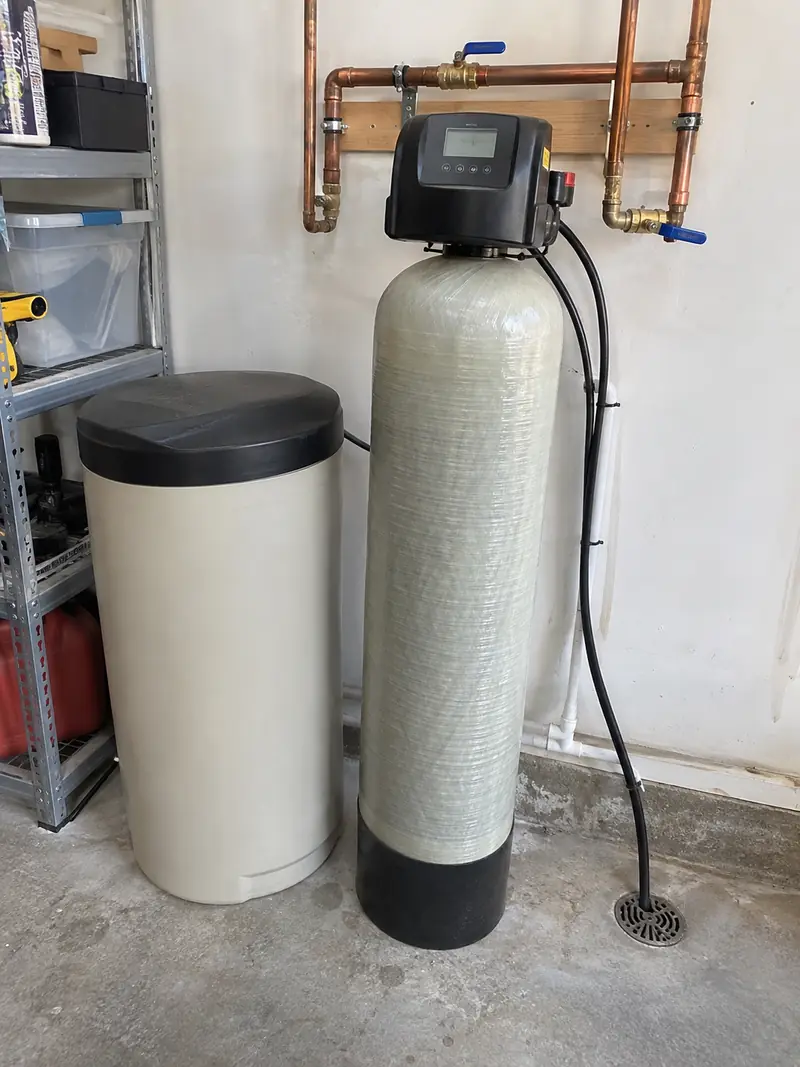
A water softener is a tank of resin beads on the main water line that takes the hardness out of every tap in the house. It’s the only common home system that does. Whether you need one comes down to a single number: your water’s hardness.
How a softener works
Hard water from the main line runs through a tank of resin beads. The beads hold sodium or potassium and swap it for the calcium and magnesium, so every tap, the water heater and the appliances get water with the hardness removed. When the beads are full, the softener rinses them with salt water from its brine tank, the trapped minerals and leftover salt go down the drain, and the beads are ready again.
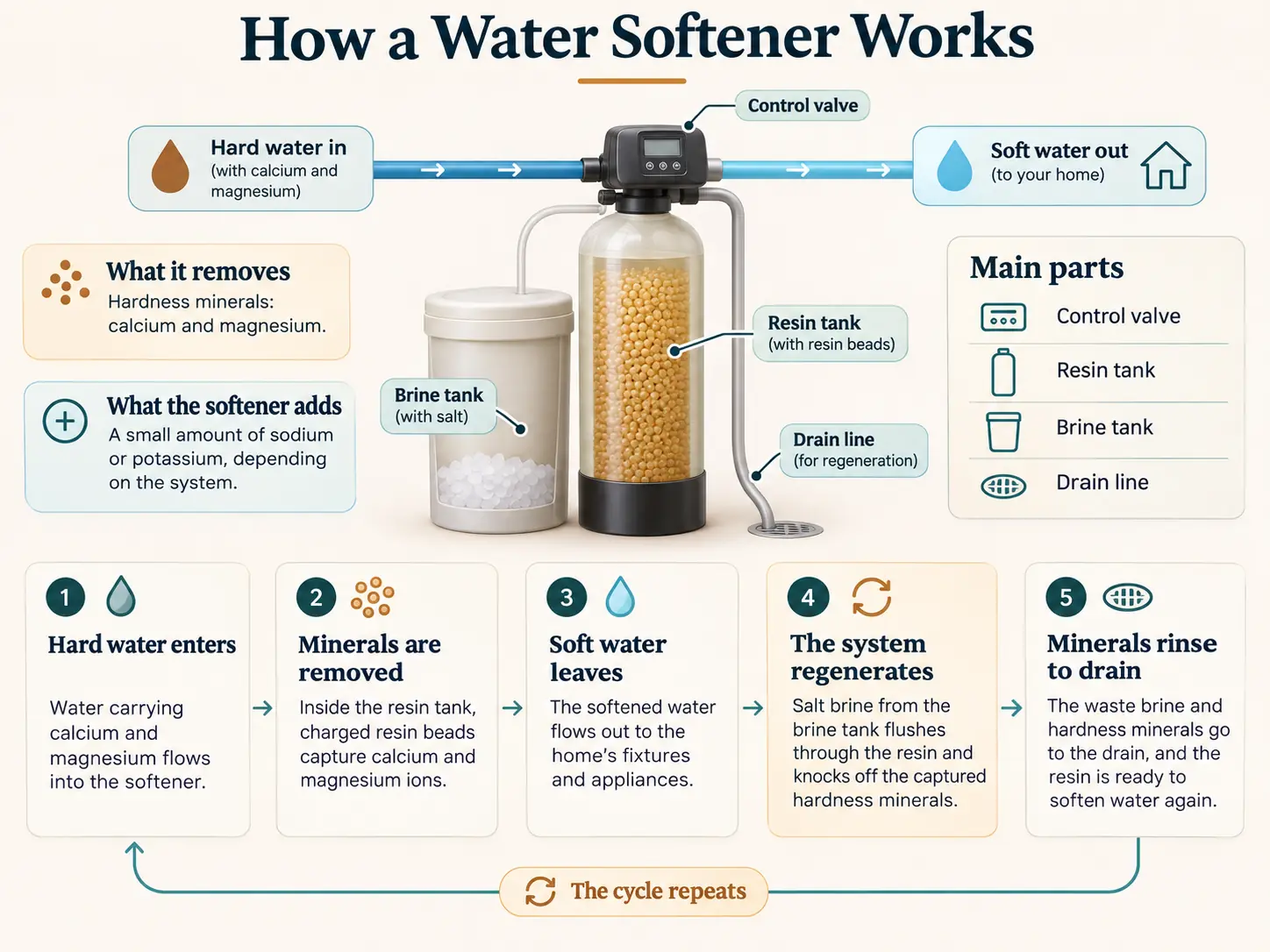
That recharge is called regenerating. A metered softener regenerates after a set amount of water has run through it; a timer softener regenerates on a schedule whether you used the water or not. The size you need depends on how hard your water is and how much your household uses, which our sizing calculator works out.
Do you need one?
Hardness has no federal health limit, so this is a household decision, not a safety one. Minnesota’s health department says softening may be warranted above about 7 grains per gallon (120 mg/L) and isn’t needed where water is already soft. Here’s where the large water systems we cover fall, by their utilities’ own reports:
Very hard · 6 systems
Indianapolis 18.5, San Antonio 17.5, Las Vegas 16.4, Jacksonville 14.4, San Diego 14.0, Tampa 10.8
Hard · 12 systems
El Paso 10.2, Philadelphia 8.9, Albuquerque 8.8, San Jose 8.8, Washington 8.1, Milwaukee 8.1, Dallas 8.0, Houston 7.9, Fort Worth 7.5, Los Angeles 7.5, Louisville 7.5, Cincinnati 7.5
Moderately hard · 10 systems
Cleveland 6.8, Columbus 6.7, Detroit 6.3, Denver 6.1, Nashville 5.9, Kansas City 5.8, Baltimore 5.5, Minneapolis 5.5, Austin 5.4, San Francisco 3.6
Grains per gallon. Classes per the U.S. Geological Survey (USGS). 6 utilities don’t publish hardness; their pages say so.
Not on the list? Your utility’s annual water quality report usually lists hardness, and a test strip gives you a number in a minute. If you’re on a private well, test it first: hardness is only one of several things worth knowing, and our well water filtration guide matches each result to its fix.
What it fixes, and what it doesn’t
A softener fixes the problems hardness causes. The World Health Organization and university extension services describe them the same way: scale in pipes, kettles and water heaters, spots on dishes and glass, and soap that won’t lather. In an industry-funded lab test, water heaters on softened water held their factory efficiency while identical ones on very hard water lost some as scale built up. Our research page has the studies, with how strong each one is.
A softener doesn’t make water cleaner in the ways most people worry about:
- PFAS (“forever chemicals”). Softeners aren’t made or certified for it. A filter certified to NSF/ANSI 53 or 58 for PFOA and PFOS is (PFAS guide).
- Chlorine and chloramine. Those need a carbon filter (chlorine vs. chloramine).
- Sodium. It adds some: about 8 mg per liter for each grain per gallon removed, according to University of Nebraska Extension. People on low-sodium diets often keep one unsoftened tap for drinking.
The main types
- Salt-based (ion exchange). The standard softener described above. It removes hardness, uses salt or potassium chloride, and needs a drain.
- Salt-free conditioners. These don’t remove hardness; they’re designed to keep it from forming scale, with no salt and no drain. Water tests just as hard afterward. See salt-free vs. salt-based.
- Dual-tank softeners. Two resin tanks take turns, so one is always in service. Useful for big households or very hard water.
What one costs
Online stores list salt-based whole-house softeners from $967 to $3,499, depending on brand and size. Culligan says its dealer-sold softeners typically cost $1,999 to $5,999, and its local dealers do the installing. Our cost guide has every price with its source, and the installation guide covers doing it yourself or hiring a plumber.
After that, a softener costs salt (or potassium chloride, which costs more), a little water and electricity for each regeneration, and occasional parts.
Questions
Do I need a water softener?
Only if your water is hard enough to cause problems. Minnesota’s health department says softening may be warranted above about 7 grains per gallon (120 milligrams per liter (mg/L)) and isn’t needed for water that’s already soft. Your utility’s water quality report or a test strip gives you the number.
What does a water softener do?
It removes calcium and magnesium, the minerals that make water hard, by swapping them for sodium or potassium on resin beads. That stops scale in pipes, water heaters and fixtures, and soap lathers more easily.
Does a water softener remove PFAS or chlorine?
No. A softener isn’t made or certified for PFAS (“forever chemicals”), and it doesn’t take out chlorine or chloramine. For PFAS, look for a filter certified to NSF/ANSI 53 or 58 for PFOA and PFOS; for chlorine, a carbon filter.
How much sodium does a water softener add?
About 8 mg per liter for each grain per gallon of hardness removed, according to University of Nebraska Extension. At 10 grains per gallon, that’s roughly 19 mg in an 8-ounce glass.
How much does a water softener cost?
Online stores list salt-based whole-house softeners from $967 to $3,499, and Culligan says its dealer-sold softeners typically cost $1,999 to $5,999. Prices read November 2026.