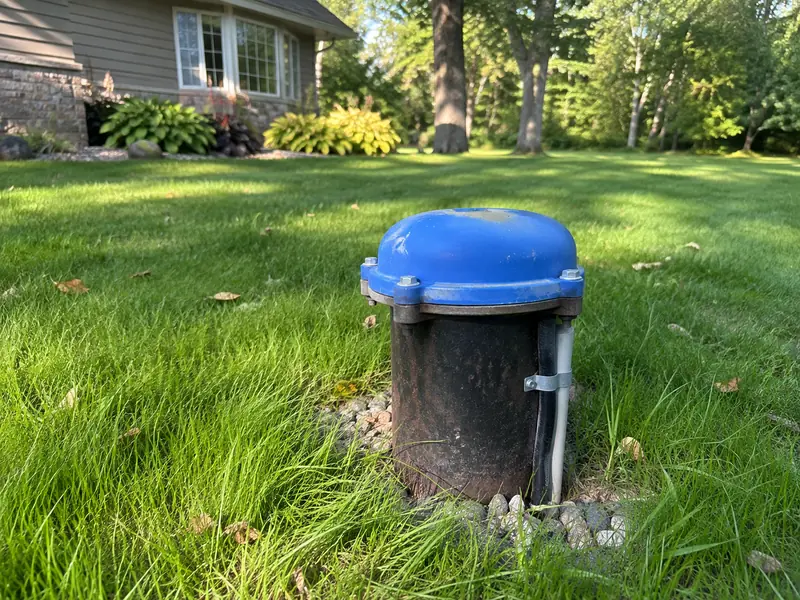
About 15% of Americans, more than 43 million people, get their drinking water from a private well, according to EPA. Unlike city water, a private well has no utility testing it and no federal rules behind it. EPA says private wells aren’t regulated under the Safe Drinking Water Act or by most state laws. Testing is the owner’s job.
That matters. EPA cites a US Geological Survey study of 2,100 private wells that found about one in five had at least one contaminant above a human-health benchmark for drinking water.
The yearly baseline
EPA recommends testing every year for four things:
- Total coliform bacteria, a sign that surface water or waste may be reaching the well.
- Nitrates, which come from fertilizer, septic systems and animal waste.
- Total dissolved solids (TDS), a general measure of minerals and salts.
- pH, which affects taste and whether water corrodes pipes.
Test more often if a young child, an older adult, or someone pregnant or nursing lives in the home.
When to test right away
EPA says to test immediately if:
- there are known groundwater or drinking water problems in your area
- conditions near the well have changed, such as flooding, land disturbance, new construction or industrial activity
- you’ve replaced or repaired any part of the well system
- the water’s smell, color or taste has changed
Beyond the baseline
Your local health department can tell you what’s common in your area’s groundwater. Arsenic, radon and uranium occur naturally in some regions; PFAS (“forever chemicals”) show up near some airports, military bases and industrial sites. If the well feeds a water softener or filter, test hardness and iron too, since both decide how big a softener needs to be. Our sizing calculator takes the hardness number.
Where to test
EPA says to use only a laboratory certified for drinking water testing. Every state runs a lab certification program with a list of approved labs, and many local health departments test private wells themselves, sometimes for free. Mail-in kits from certified labs work too, as long as the lab, not the kit maker, is certified for the tests you order.
What to do with the results
Each problem a test can turn up has its own fix: a softener for hardness, an oxidizing filter for iron and rotten-egg smell, ultraviolet light for bacteria, a neutralizer for acidic water, and reverse osmosis at the kitchen tap for nitrate or arsenic. Our well water filtration guide matches each result to its treatment, with store prices.
Questions
How often should I test my well water?
At least once a year for total coliform bacteria, nitrates, total dissolved solids and pH, according to the U.S. Environmental Protection Agency (EPA). Test more often if a young child, an older adult, or someone pregnant or nursing lives in the home.
What should well water be tested for?
The U.S. Environmental Protection Agency’s (EPA’s) yearly baseline is total coliform bacteria, nitrates, total dissolved solids and pH. Add anything your local health department says is common in your area’s groundwater, such as arsenic, radon, uranium or PFAS (“forever chemicals”).
Who regulates private wells?
Nobody at the federal level. The U.S. Environmental Protection Agency (EPA) says private wells aren’t regulated under the Safe Drinking Water Act or by most states, so the owner is responsible for testing and treatment.
Where can I get my well water tested?
At a state-certified drinking water laboratory. Your state’s lab certification office keeps a list, and many local health departments offer private well testing, sometimes free.