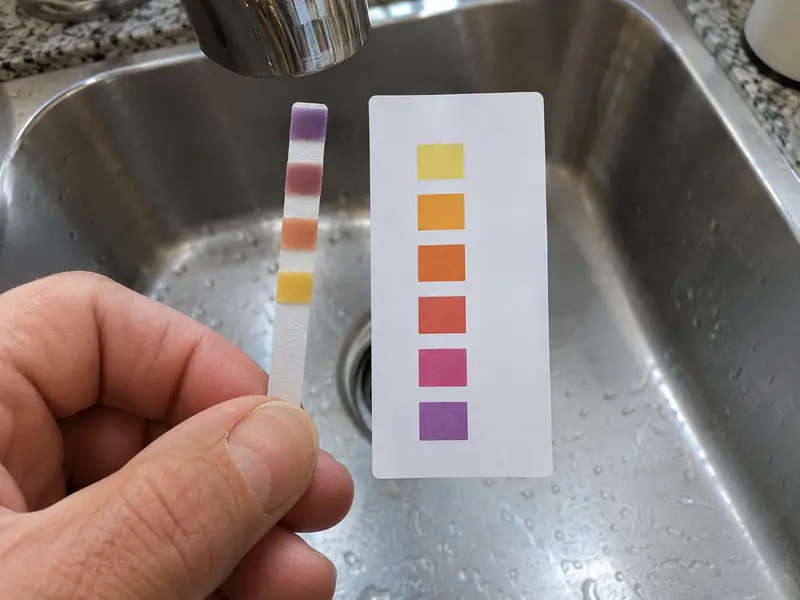
Hardness is the one number that decides whether a softener is worth buying and how big it needs to be. There are four ways to get it, from free to lab-grade.
1. Look it up (free)
If you’re on city water, your utility tests hardness and usually prints it in its annual water quality report, sometimes called a Consumer Confidence Report. Each of our city pages has the number from that report, with a link to it. Not every utility includes it, since hardness has no federal limit: of the systems we cover, 6 don’t, including Chicago, Miami, Phoenix. If yours is one of them, or the report gives a wide range, test it yourself.
2. Test strips (about a minute)
Dip a strip in a glass of cold tap water, wait the time on the package, and match the pad’s color to the chart. Strips give a range rather than an exact number, which is usually enough to tell soft water from hard. Read the package for the units: most strips use grains per gallon or parts per million (ppm).
3. Drop-count kits (a closer number)
A drop-count (titration) kit has you add a reagent to a measured sample one drop at a time until it changes color. The number of drops gives the hardness, usually in grains per gallon. It takes a few minutes and gives a more exact number than a strip, which helps when you’re sizing a softener close to the line between two capacities.
4. A certified lab (most precise)
A lab test gives an exact figure and can test for other things at the same time. If you’re on a private well, that’s the better route: the U.S. Environmental Protection Agency (EPA) recommends testing wells every year with a certified drinking water lab, and iron, which also affects softener sizing, is worth testing alongside hardness. Our well water testing guide covers what to ask for.
Taking the sample
- Use a cold tap. Hot water has been through the water heater, where some hardness can settle out as scale.
- Test before any treatment. A kitchen tap after a softener or filter tells you about the treated water, not what’s coming in. An outdoor spigot often bypasses the softener.
- To check a softener, test once before it and once after. Softened water should read at or near zero.
Reading the result
Hardness shows up in three units, and two of them are the same number:
- mg/L as calcium carbonate and ppm are the same number.
- Grains per gallon (gpg) is mg/L divided by 17.1.
On the U.S. Geological Survey (USGS) scale, under 60 mg/L (about 3.5 gpg) is soft, 61 to 120 is moderately hard, 121 to 180 is hard, and over 180 (about 10.5 gpg) is very hard. Minnesota’s health department says softening may be warranted above about 7 gpg (120 mg/L). Put your number into our sizing calculator to see what size softener it calls for, or read hard water, explained for what each level means at home.
Questions
How do I test my water hardness at home?
Dip a hardness test strip in a glass of cold tap water and match its color to the chart, which gives a range. A drop-count kit, where you add drops until the sample changes color, gives a more exact number. Use the cold tap before any softener or filter.
What is a good water hardness level?
There’s no health limit for hardness. By the U.S. Geological Survey (USGS) scale, under 60 milligrams per liter (mg/L; about 3.5 grains per gallon) is soft and over 180 mg/L (about 10.5) is very hard. Minnesota’s health department says softening may be warranted above about 7 grains per gallon (120 mg/L).
How do I convert ppm or mg/L to grains per gallon?
Divide by 17.1. Hardness in milligrams per liter (mg/L) as calcium carbonate and in parts per million (ppm) is the same number, so 171 mg/L or 171 ppm is about 10 grains per gallon.
How can I tell if my water softener is working?
Test the water at a tap after the softener and compare it with a sample taken before it, such as an outdoor spigot that bypasses it. Softened water should test at or near zero.