PFAS (per- and polyfluoroalkyl substances) are a group of manufactured chemicals used since the 1940s in products like nonstick cookware, stain- and water-repellent fabrics and firefighting foam. Many break down very slowly and build up in people and the environment, which is why they’re called “forever chemicals.”
PFOA and PFOS are two of them, and two of the most widely used and studied. US manufacturers have since replaced them with other PFAS, but they’re still found in tap water, and they’re the two EPA regulates most tightly.
What the 2024 rule set
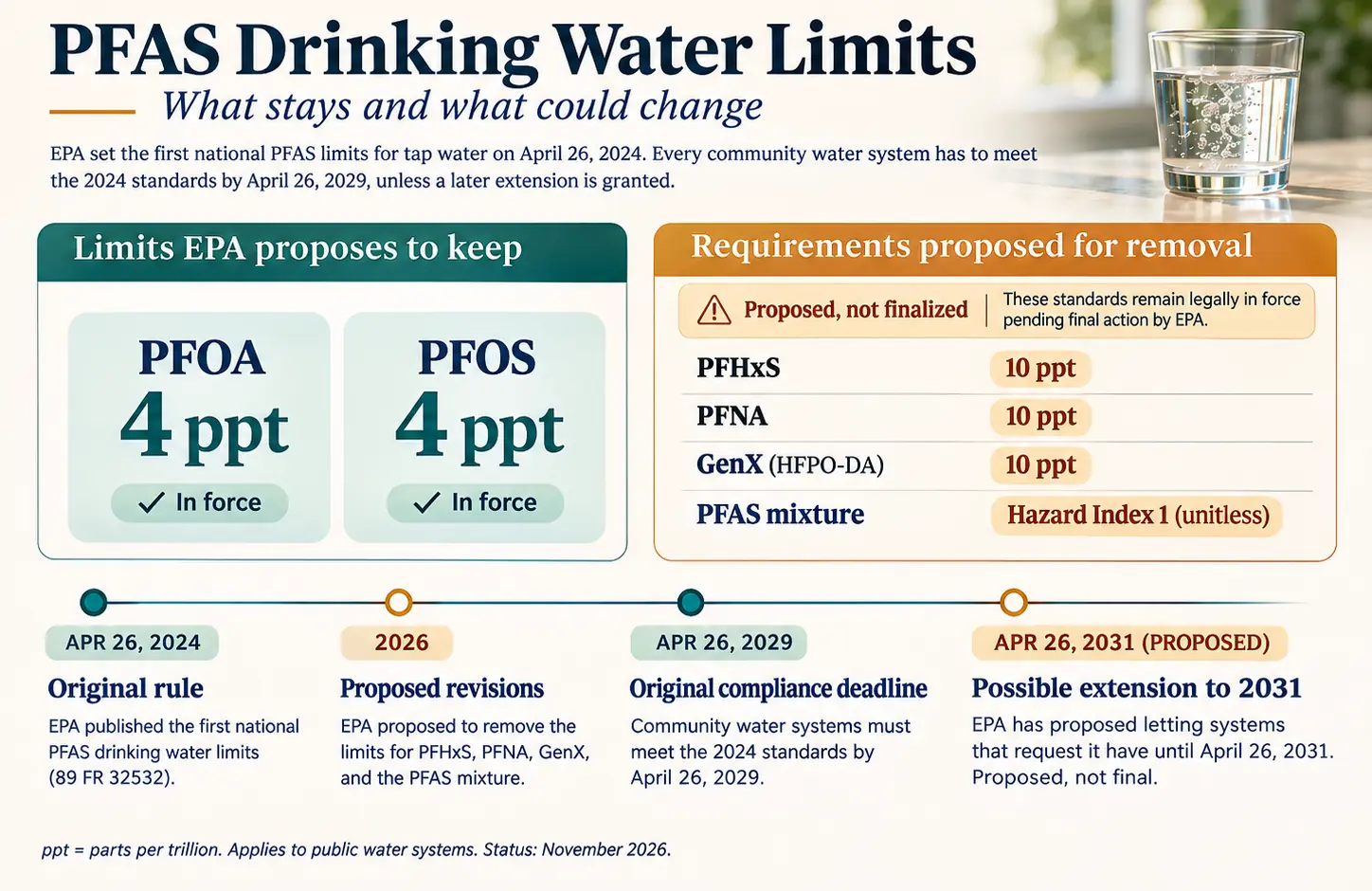
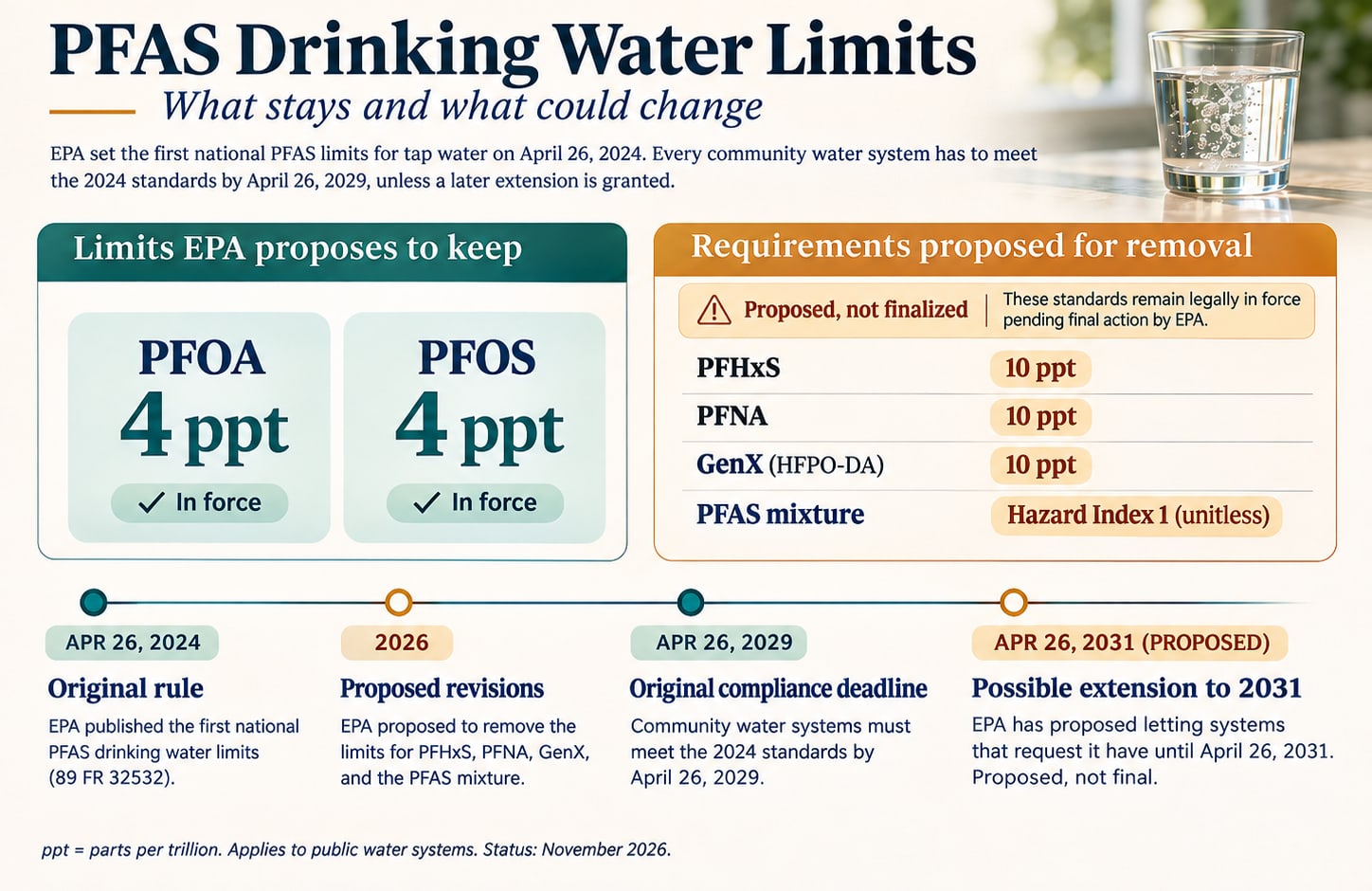
EPA set the first national PFAS limits for tap water in April 2024. Every community water system has to meet them by April 26, 2029. The rule covers six things, measured in parts per trillion (ppt):
- PFOA and PFOS: 4 ppt each. EPA plans to keep these limits.
- Three other PFAS chemicals, PFHxS, PFNA and GenX: 10 ppt each. EPA has proposed removing these.
- Mixtures of those three plus a fourth PFAS chemical, PFBS: one combined limit, which EPA calls a Hazard Index. Also proposed for removal.
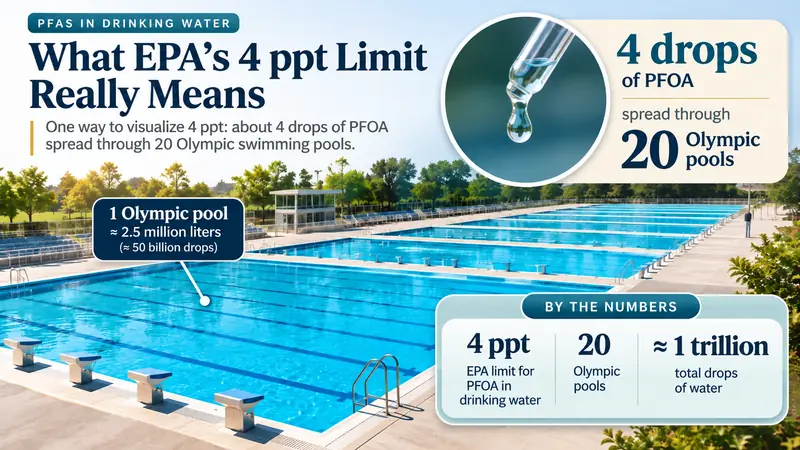
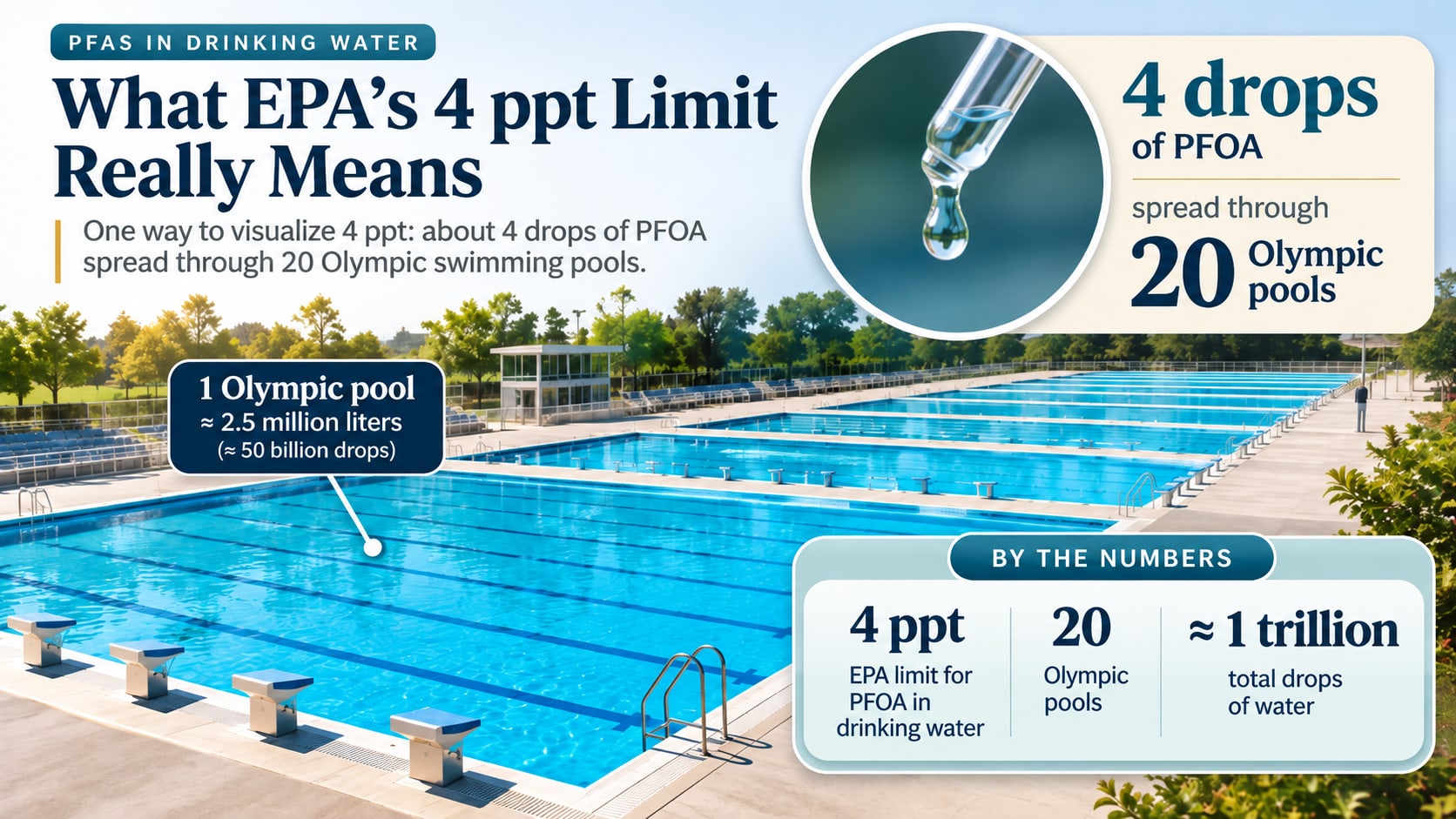
A part per trillion is a very small amount: about one drop in 20 Olympic swimming pools. EPA’s health goal for PFOA and PFOS is zero, and it set the enforceable limit at 4 ppt because that’s the lowest level labs can reliably measure.
What changed in 2026
EPA published two proposals on May 20, 2026:
- More time for PFOA and PFOS. A water system that asks for it would have until April 26, 2031, instead of April 26, 2029, to meet the 4 ppt limits.
- Dropping the other limits. The limits for PFHxS, PFNA and GenX, and the combined mixture limit, would be removed.
Public comments closed on July 20, 2026. Neither proposal was final when we last checked on November 4, 2026.
The 2024 rule is also being challenged in court by the American Water Works Association, a water industry group, in the U.S. Court of Appeals for the D.C. Circuit. In January 2026 the court turned down EPA’s request to throw out the parts of the rule it now wants to drop. We’ll update this page when the court rules or EPA finalizes either proposal.
How to read a PFAS result for your city
Most PFAS numbers you’ll see, including ours, come from EPA’s national testing program, the fifth Unregulated Contaminant Monitoring Rule (UCMR 5). Between 2023 and 2025 it sampled every water system serving more than 3,300 people, plus some smaller ones.
Those results are single samples. They aren’t how EPA decides whether a utility is following the rule: starting in 2029, that will be judged on a yearly average of the samples at each testing point. So a sample above 4 ppt means the utility may need to bring its levels down by the deadline. It doesn’t mean the utility is breaking the law today.
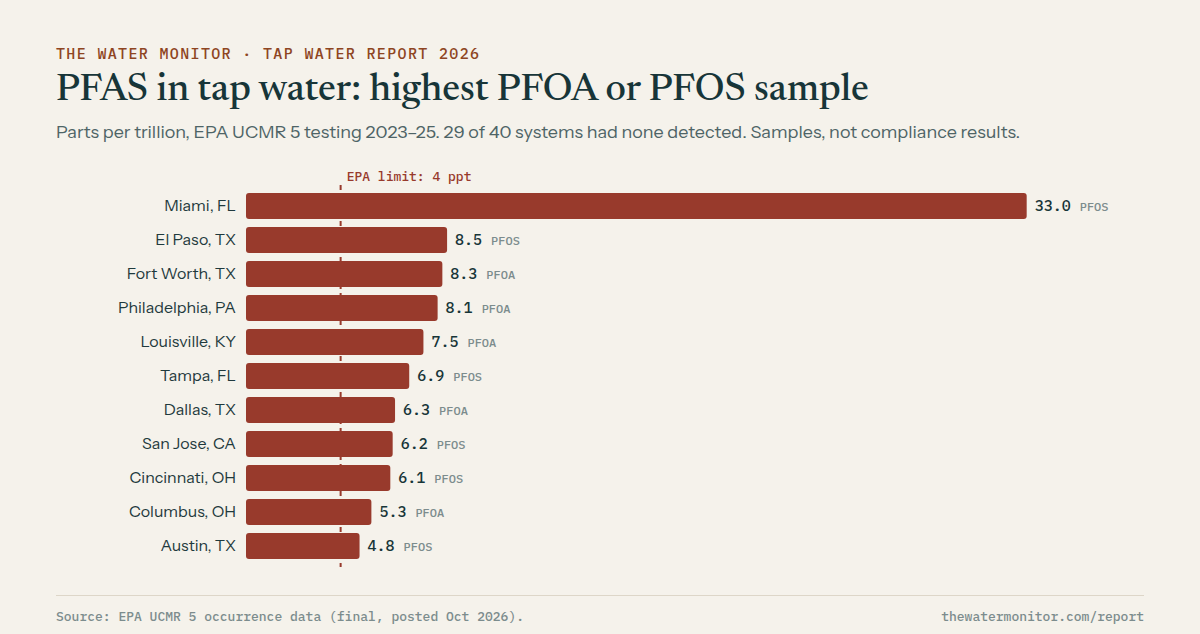
11 of the 40 cities we cover had at least one PFOA or PFOS sample above 4 ppt:
The other 29 had none at or above 4 ppt. The chart shows each city’s highest sample, and each city page lists every result.
What you can do at home
If your utility’s PFAS numbers are above the limit, the cheapest fix is a filter on the tap you drink and cook from. EPA’s limits are built around the water people drink, so that’s where most households start.
Two kinds of home filters have independent certification for it:
- Reverse osmosis units certified to NSF/ANSI 58, the standard for reverse osmosis systems, for PFOA and PFOS reduction.
- Carbon filters certified to NSF/ANSI 53, the standard for filters that reduce health-related contaminants, for PFOA and PFOS reduction.
Check the certification for those two chemicals by name. “Reduces PFAS” on a box isn’t the same claim.
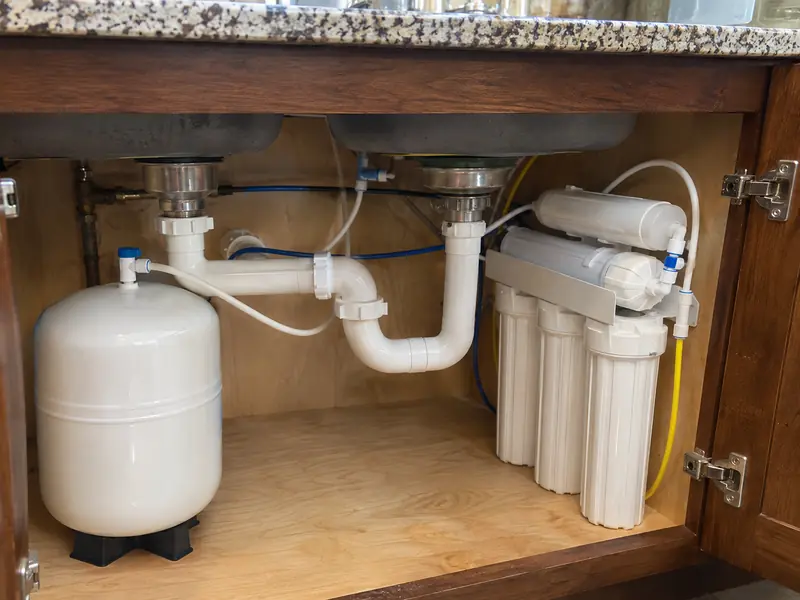
An under-sink reverse osmosis system works in stages:
- A sediment filter catches sand, rust and grit that would clog the later stages.
- A carbon filter removes chlorine, which would damage the membrane, and improves the taste.
- The membrane lets water through but blocks most dissolved substances, PFAS included.
- A storage tank holds the filtered water, because the membrane makes it slowly. Inside, a bladder of filtered water sits in a pocket of compressed air, and the air pushes the water out when you open the faucet. Tankless models skip the tank and use a pump instead.
- Its own faucet at the sink delivers the water for drinking and cooking. The same line can also run to a refrigerator’s water dispenser and ice maker.
The membrane rinses itself with part of the incoming water, so a reverse osmosis system sends some water down the drain for every gallon it filters.
Questions
What is the legal limit for PFAS in drinking water?
Under the U.S. Environmental Protection Agency’s (EPA’s) 2024 rule, the limit is 4 parts per trillion (ppt) each for PFOA and PFOS, the two most widely used and studied PFAS, or “forever chemicals.” The rule also set limits of 10 ppt each for three other PFAS chemicals (PFHxS, PFNA and GenX) and a combined limit for mixtures of them. In May 2026 EPA proposed removing those other limits and keeping the 4 ppt limits for PFOA and PFOS; as of November 4, 2026 that wasn’t final.
When do water utilities have to meet the PFAS limit?
By April 26, 2029. A May 2026 proposal would let a system that asks for it have until April 26, 2031 for PFOA and PFOS (two PFAS “forever chemicals”). It applies only to systems that request it.
My city had a PFAS sample above 4 ppt. Is it breaking the law?
Not on the strength of one sample. The U.S. Environmental Protection Agency (EPA) judges compliance on a yearly average at each sampling point, and the deadline is 2029. EPA’s national testing (the fifth Unregulated Contaminant Monitoring Rule, or UCMR 5 (EPA’s national testing program)) shows where levels are high enough to need treatment before then.
Do home filters remove PFAS?
Some do, with independent certification. Look for a reverse osmosis unit certified to NSF/ANSI 58 (the standard for reverse osmosis systems) or a carbon filter certified to NSF/ANSI 53 (the standard for filters that reduce health-related contaminants), and check that the certification names PFOA and PFOS (two PFAS “forever chemicals”), the two PFAS the U.S. Environmental Protection Agency (EPA) limits most tightly.