Skin and eczema
This is the most studied question, and the answer is less clear than softener ads suggest. Several large observational studies found eczema was somewhat more common in babies living in harder-water areas. A 2021 review pooled them and rated the certainty "very low," and other studies, in Spain and New Hampshire, found no link.
The best test of whether softening helps is a trial, and the largest one found it didn’t: children’s eczema improved about the same with a softener (20%) as without one (22%). Whether softening water before birth could prevent eczema is still an open question; the pilot trial was too small to say.
What this doesn’t show: that hard water causes eczema, or that a softener treats or prevents it.
- Moderate evidenceObserver-blinded, multicentre randomised controlled trial
In the largest trial so far, installing a water softener did not improve eczema severity in children more than usual eczema care alone.
Limits: Families could not be blinded because softened water feels different; parent-reported outcomes (POEM, Dermatitis Family Impact, well-controlled weeks) showed small differences favouring softeners, which the authors attribute mainly to response bias. Only 12 weeks. Children with moderate-to-severe eczema only; does not test prevention in babies. Soap use not monitored. Full text read (open access).
- Moderate evidenceMeta-analysis of randomised controlled trials within a systematic review
Pooled results from two randomised trials found no evidence that home water softeners improve the objective severity of existing eczema.
Limits: Abstract only (paywalled). Only two trials; both in people who already had eczema, so they do not answer whether softening prevents eczema in newborns.
- Weak evidenceSystematic review and random-effects meta-analysis with GRADE assessment
Across observational studies, children living in harder-water areas had somewhat higher odds of eczema, but reviewers rated the certainty of this evidence as very low.
Limits: Abstract only (paywalled). Pooled studies are observational and mostly assign hardness by area, not by measuring each home; cannot separate hardness from chlorine or other area-level factors. Several review authors (Flohr, Danby, Cork) also led primary studies in this field, such as Perkin 2016 and Danby 2018.
- Weak evidencePopulation-based cross-sectional study
In a UK study of 1,303 three-month-old babies, eczema was more common in homes with harder water; any separate role of chlorine was unclear.
Limits: Abstract only (paywalled). One point in time, so it cannot show cause. Hardness and chlorine were strongly correlated and came from water-supplier area data, not home testing. Groups split at the median. Larger effect in babies with filaggrin gene mutations was not statistically confirmed. The abstract reports no data on bathing habits or swimming.
- Weak evidenceLarge prospective birth cohort
In a Danish cohort of about 53,000 children, eczema by 18 months was slightly more common as household water hardness rose.
Limits: Abstract only (paywalled). Eczema based on parent interview of physician diagnosis. Hardness assigned from geological survey data, not measured at the tap. All Danish homes were moderately hard or harder, so there was no truly soft-water comparison group. Small effect size; residual confounding possible.
- Mixed evidenceProspective mother-child birth cohort
A Spanish birth cohort of 1,638 children found no link between home water hardness and eczema at 14 months or 4 years.
Limits: Abstract only (paywalled). Eczema by parent questionnaire. Municipal average hardness, not home measurements. Lower hardness range than the Danish cohort.
- Weak evidenceProspective birth cohort analysis
In a New Hampshire birth cohort where most homes had soft water, there was no clear overall trend between tap-water hardness and infant eczema.
Limits: Full text read via PMC10023435. Parent-reported eczema only; no data on bathing, soaps or emollients; narrow, mostly soft hardness range; post hoc trend tests. A 2025 correction exists; the publisher page blocked automated reading, so its content was not checked.
- Weak evidenceEcological study using GIS-linked questionnaire data
An early English study found eczema was more common among primary-school children in harder-water areas, but not among secondary-school children.
Limits: Abstract only (paywalled). Ecological design links area-level water data to area eczema rates; questionnaire-based eczema; chlorine trend not independently significant.
- Weak evidenceAssessor-blinded pilot randomised controlled trial
A small pilot trial showed it is feasible to test whether softening water before birth prevents eczema, but it was too small to show whether it works.
Limits: Abstract only (paywalled). Not powered for effect; wide confidence interval includes no difference. 28% of eligible families could not install a softener (technical reasons or landlord). Families at high risk of allergy only.
- Weak evidenceExperimental mechanistic studyIndustry-funded
In a lab test on 80 people, washing with very hard water left about 2.8 times more of a common cleanser ingredient on the skin than deionized water, and the residue increased irritation, especially in people with eczema.
Limits: Short-term lab model on small skin sites using one surfactant; not real-world bathing. Compared very hard water with deionized water. Read from the open-access author manuscript on the King’s College London repository (publisher site blocked automated reads).
Hair
The research is thin: a few small lab studies on cut strands of hair, and they disagree. None tested people’s hair over time.
- Weak evidenceLaboratory study on cut hair strands
A small lab test found no difference in strength or stretch between hair strands soaked in hard water and in distilled water for 30 days.
Limits: Very small; hair strands soaked in water, not washed on a living scalp; no shampoo; one hardness level. Abstract and record read via PMC (open access).
- Weak evidenceLaboratory study on cut hair strands
A second small lab study found hair strands treated with very hard water were about 8% weaker than untreated strands.
Limits: Lab soaking of strands, not real washing; hardness level of the test water not given in the abstract; men only; single region in Pakistan. Measures strand strength, not hair loss.
- Weak evidenceLaboratory study
A small electron-microscope study found more magnesium deposits on hair washed in hard water, but no visible structural damage.
Limits: Abstract only (paywalled). Very small; 3-week treatment of cut samples; hardness level not stated in abstract.
Around the house
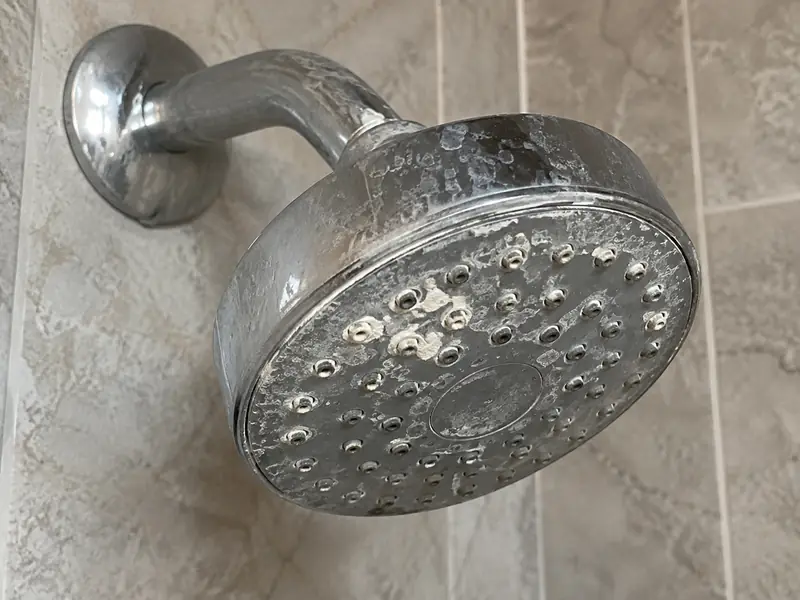
Here the effects are well established in principle. Hard water needs more soap, forms soap curd and gray laundry, and leaves scale in pipes, fixtures and water heaters. How big the effect is depends on how hard the water is, and most of the numbers come from tests funded by the water treatment industry using very hard water (26 to 30 grains per gallon), harder than the typical water in every city we cover.
What this doesn’t show: the widely repeated "75% loss of shower flow" figure, which isn’t in the study’s own summary. The study’s modeled long-term water heater losses range from about 4% to 26% depending on hardness.
- Strong evidenceInternational agency guideline background document
The World Health Organization says hard water needs more soap and forms scale in pipes and water heaters, very soft water can corrode pipes, and it sets no health-based limit for hardness.
Limits: Mainly qualitative on household effects; does not quantify energy or detergent costs. Notes that soft water that is not stabilized can raise lead and copper levels through corrosion.
World Health Organization. (2011). Hardness in Drinking-water: Background docume
- Moderate evidenceUniversity extension guidance
University extension guidance says hard water is not a health hazard but makes soap form a sticky curd that can leave film on skin and hair, gray laundry, spot dishes and clog pipes with scale.
Limits: Expert guidance rather than measured data; skin and hair statements are descriptive, not from trials. Classification scale differs slightly from WHO’s.
- Moderate evidenceIndustry-funded accelerated-scaling laboratory engineering studyIndustry-funded
In an industry-funded lab test using very hard water, gas and tankless water heaters lost some efficiency as scale built up, while identical units on softened water stayed at factory efficiency.
Limits: Accelerated conditions; all unsoftened units were removed early because outlet piping clogged. Long-term figures are model extrapolations whose usage assumptions are not detailed in the executive summary. Executive summary only; WQRF says full reports are available on request. Not peer reviewed. WQRF says it is repeating the study starting in 2026.
Battelle Memorial Institute for the Water Quality Research Foundation. (2009). S
- Moderate evidenceIndustry-funded accelerated laboratory engineering studyIndustry-funded
In the same industry-funded test, low-flow showerheads and faucets on very hard water clogged quickly, and dishwashers and clothes washers showed visible scale after 30 days.
Limits: Accelerated test on hot water from tankless heaters; much of the faucet clogging came from scale breaking loose upstream. The widely repeated '75% flow loss in 18 months’ figure does not appear in this executive summary. Executive summary only.
Battelle Memorial Institute for the Water Quality Research Foundation. (2009). S
- Moderate evidenceEngineering field test of residential water heaters at four US sites
An older multi-city field test found gas water heaters lost about 5% efficiency after heavy scale buildup, while electric heaters kept their efficiency but had heating elements fail.
Limits: Abstract only (OSTI has no digital full text). Number of units not given. 1980s equipment.
- Weak evidenceIndustry-funded laboratory performance test following ASTM D3556Industry-funded
An industry-funded lab study found dishes washed in softened water came out cleaner with fewer spots, even with less detergent, than dishes washed in very hard water.
Limits: Executive summary only; full report on request. 'Up to 70%' compares softened water with very hard water (30 grains per gallon), not typical homes. Not peer reviewed. Detergent formulas have changed since 2010; WQRF says it is repeating the study starting in 2026.
- Weak evidenceIndustry-funded laboratory stain-removal test following ASTM D4265Industry-funded
An industry-funded lab study found clothes washed in softened water with half the detergent in cold water got stains out as well as or better than full detergent in warm, very hard water.
Limits: Executive summary only; full report on request. Comparison is with very hard water (30 grains per gallon, or 513 parts per million). Not peer reviewed. Detergent formulas have changed since 2010.
Heart health and kidney stones
The World Health Organization reviewed the evidence and found no link between overall hardness or calcium and heart attacks or heart-disease deaths. Several observational reviews suggest more magnesium in water may go with somewhat lower cardiovascular death rates, but that’s unproven. For kidney stones, the evidence points to how much you drink, not how hard the water is.
What this doesn’t show: that hard water protects your heart, or that it causes kidney stones.
- Weak evidenceInternational agency expert consensus meeting report and review
WHO’s expert review found no link between overall water hardness or calcium and heart attacks, and a possible but unproven link between more magnesium in water and fewer heart-disease deaths.
Limits: Underlying studies are observational, mostly ecological; magnesium association not shown to be causal. Report is from 2009.
World Health Organization. (2009). Calcium and magnesium in drinking-water: publ
- Weak evidenceSystematic review with meta-analysis of case-control studies
A systematic review found people with more magnesium in their drinking water had lower rates of cardiovascular death in case-control studies, but found no link for overall hardness in cohort studies.
Limits: Abstract only (paywalled). Observational studies only; substantial heterogeneity; mostly European data.
- Weak evidenceMeta-analysis of observational studies
A meta-analysis linked higher magnesium in drinking water with somewhat lower coronary heart disease death rates, mostly in European studies.
Limits: Abstract read. High heterogeneity; 9 of 10 studies from Europe; observational; borderline confidence interval.
- Weak evidenceSystematic review and meta-analysis of case-control studies
A meta-analysis of case-control studies suggested both calcium and magnesium in water were linked to lower cardiovascular risk, but the authors warned the results were inconsistent and possibly affected by publication bias.
Limits: Abstract only (paywalled). High heterogeneity and publication bias; highest-vs-lowest comparisons with different cut points across studies.
- Strong evidenceFederal health agency patient guidance
The National Institutes of Health says drinking enough fluid, mainly water, is the most important thing you can do to prevent kidney stones; its guidance does not mention water hardness.
Limits: Last reviewed 2017. General guidance, not specific to tap-water minerals.
National Institute of Diabetes and Digestive and Kidney Diseases (NIDDK), NIH. E
- Weak evidenceProspective cohort study
In a UK study of about 288,000 adults, overall water hardness and calcium were not linked to new kidney stones, while higher magnesium in water was linked to slightly fewer stones.
Limits: Abstract read. Water hardness assigned by area; many subgroup analyses raise the chance of false positives; UK population.
- Weak evidenceCross-sectional analysis of stone-former records linked to public water supply hardness by
Among about 4,800 US patients who form calcium stones, those in hard-water areas did not have more stones; the softest-water group actually had slightly more lifetime stones.
Limits: Abstract only (paywalled). Only people who already form stones; water hardness from public supply records by ZIP code, not home taps; authors call the impact 'unclear'.
- Weak evidenceSystematic review
A systematic review found no consensus on hard vs soft water for kidney stones, noting that drinking more fluid prevents stones and that mineral-rich water may even help some calcium stone formers.
Limits: Abstract only (paywalled). Narrative synthesis of heterogeneous studies; number of studies not stated in abstract.
Sodium from a water softener
A standard softener swaps hardness minerals for sodium. The amount depends on how hard your water was: about 8 mg per liter for each grain per gallon removed. For most people that’s small next to food. People on a strict low-sodium diet have simple options.
- Strong evidenceUniversity extension guidance
An ion-exchange softener adds about 8 mg of sodium per liter for each grain per gallon of hardness removed, which works out to roughly 2 mg per 8-ounce glass per grain.
Limits: Rate assumes all hardness is removed; actual sodium also depends on sodium already in the source water. The rate originates with the Water Quality Association (industry group), but it follows from simple ion-exchange chemistry and matches the Arizona extension figure.
- Strong evidenceUniversity extension publication
University of Arizona Extension gives the same rule of thumb: grains per gallon of hardness times 7.9 equals the milligrams per liter of sodium a softener adds.
Limits: Arizona focus; the publication advises avoiding drinking softened water, which is the authors’ recommendation rather than a regulatory requirement.
- Strong evidenceFederal agency drinking water advisory
EPA’s guidance level for sodium in drinking water is 20 milligrams per liter (mg/L) for people on a very strict 500 mg-a-day sodium diet; it is not a limit for the general public.
Limits: From 2003; not federally enforceable; 20 mg/L should not be extrapolated to the whole population (EPA’s own wording).
US EPA Office of Water. (2003). Drinking Water Advisory: Consumer Acceptability
- Strong evidenceState health department guidance
Minnesota’s health department advises people on low-sodium diets to keep an unsoftened tap for drinking and cooking, consider potassium chloride instead of salt, and talk to a doctor if anyone has high blood pressure.
Limits: Guidance, not research; no per-glass figure.
Minnesota Department of Health. Home Water Softening Frequently Asked Questions
Pets
We found no peer-reviewed veterinary study of tap water hardness and urinary stones in cats or dogs. The veterinary consensus focuses on diet and getting pets to drink more. The one widely cited claim comes from a pet insurer’s press release, not a study.
- Moderate evidenceSpecialty college consensus statement
The main veterinary consensus on preventing urinary stones in dogs and cats focuses on diet and getting pets to take in more water; it does not mention tap-water hardness.
Limits: Consensus/expert opinion; absence of a hardness recommendation is not evidence that hardness has no effect. Full text read via Europe PMC (PMC5032870).
- Moderate evidenceScoping review
Research on cats shows that total water intake, mostly driven by wet vs dry food, affects how concentrated their urine is, which matters for crystals and stones.
Limits: Abstract read (open access, PMC12893781). Scoping review, no pooled effect; does not study water hardness.
- Weak evidenceRandomised block cross-over feeding studyIndustry-funded
In a small cat feeding study, adding water to food made urine more dilute and lowered the calcium-oxalate crystal risk measure.
Limits: Abstract only. Six cats, 3-week periods; measures a risk marker, not actual stones; struvite effect unclear.
- Weak evidenceInsurance claims correlationIndustry-funded
A pet insurer’s claims analysis found more urinary claims for male cats in cities with extremely hard water, but it is an unpublished correlation and the insurer’s own vet said further study is warranted.
Limits: Not peer reviewed; no methods, no adjustment for diet, age, breed or other factors; city-level hardness ratings; one company’s insured pets. CVO: 'Further study is warranted.'
Trupanion. (2016, April 7). Trupanion Study Finds Link Between Pet Health and Dr
- Weak evidenceCase report
In one lab colony, guinea pigs given extremely hard water from a malfunctioning treatment system developed mineral deposits in the kidneys and blood vessels, which stopped after the water was fixed.
Limits: Abstract only (paywalled). Single colony; water was far harder than typical tap water due to a malfunction; guinea pigs only; feed cause not fully excluded.
How we gathered these
Every source above was opened and read in November 2026, from agency reports, trial publications, PubMed records and extension guides. Where only an abstract was available, the "Limits" line says so. We list industry-funded studies because they’re often the only data on household effects, and mark them.
Questions
Does hard water cause eczema?
It has not been shown to. Observational studies link harder water with somewhat more eczema in babies and young children, and a 2021 review rated that evidence very low certainty. Several studies found no link. In the largest trial, 336 children, installing a softener did not improve existing eczema more than usual care.
Is hard water bad for your hair?
There is little evidence either way. The studies are small lab tests on cut strands and they disagree: one found no difference, one found strands about 8% weaker, one found mineral deposits but no structural damage.
Does hard water damage water heaters?
It builds scale, and industry-funded lab tests with very hard water (26 grains per gallon) found gas storage heaters fell from 70.4% to 67.4% efficiency and tankless heaters from 80% to 72%. Electric heaters kept their efficiency but collected scale. These studies were funded by the water treatment industry and are not peer reviewed.
How much sodium does a water softener add?
About 8 mg per liter for each grain per gallon of hardness removed, according to university extension guidance. At 10 grains per gallon that works out to roughly 19 mg in an 8-ounce glass (our arithmetic from that rate). People on low-sodium diets can keep an unsoftened tap for drinking or use potassium chloride.
Does hard water cause kidney stones?
Not according to the evidence. In a UK study of about 288,000 adults, hardness and calcium in water were not linked to new kidney stones. The NIH says drinking enough fluid is the most important way to prevent stones.